
Security Tools - CISM Domain 3
Estimated reading time: 8 minutes

Fawad Mehmood Expert review Last Updated On:
CISM Domain 3 - Security Tools MindMap
Download FREE Audio Files and Printable PDFs of our MindMaps
Your information will remain 100% private. Unsubscribe with 1 click.
Transcript
Introduction
Hey, I’m Nick from Destination Certification, and I’m here to help YOU pass the CISM exam.
In this video, we’re going to break down a full MindMap of some of the most important concepts in Security Tools from Domain 3— not just to help you memorize terms, but to really understand how they interconnect and why they matter.
This is the ninth of thirteen videos for domain 3. I have included links to the other MindMap videos in the description below. These MindMaps are one part of our complete CISM MasterClass.
Detect, prevent, and respond to evolving threats.
The question we will try to address today is: What does it really take to build a security program that can stand up to modern threats?
A very short answer to this is that modern security operates on three critical pillars. Detection identifies threats before they cause damage, prevention blocks known attack vectors, and response capabilities ensure rapid containment when breaches occur. This triad approach recognizes that no single defense is perfect - you need overlapping capabilities that adapt as threats evolve, creating resilience through redundancy. In that sense, security tools need to detect, prevent, and respond to evolving threats. Now, how exactly are they going to do that?
Network Security
A reasonably good place to start is with effective Network Security.
Network security protects data as it moves between systems. Your network perimeter acts as the first line of defense, examining packets, analyzing traffic patterns, and blocking malicious connections before they reach internal resources. Some of the main forms of Network Security include firewalls, IDS and IPS.
Firewalls

Firewalls serve as your network's gatekeepers, enforcing security policies by controlling traffic flow between network segments. Modern firewalls have evolved far beyond simple port blocking - they inspect application data, track connection states, and make intelligent decisions about what traffic to allow. It’s like picking the right doorman for each door — some just check IDs, others scan bags, and a few won’t let anyone in without a full background check. One particular doorman we will discuss first is packet filtering.
Packet Filtering
Packet filtering examines individual packets against predefined rules, checking source and destination addresses, ports, and protocols to make allow or deny decisions.
Stateful Inspection
Next, let us discuss stateful inspection. It tracks active connections and their states, allowing legitimate return traffic while blocking unsolicited inbound connections that don't match established sessions.
Proxy Circuit and Application
Proxy firewalls act as intermediaries between clients and servers. Circuit-level proxies validate TCP handshakes, while application proxies understand specific protocols like HTTP, providing deep inspection and content filtering capabilities. Now that we’ve reviewed the main firewall types, let’s discuss other security tools – starting with Intrusion Detection Systems.
IDS and IPS
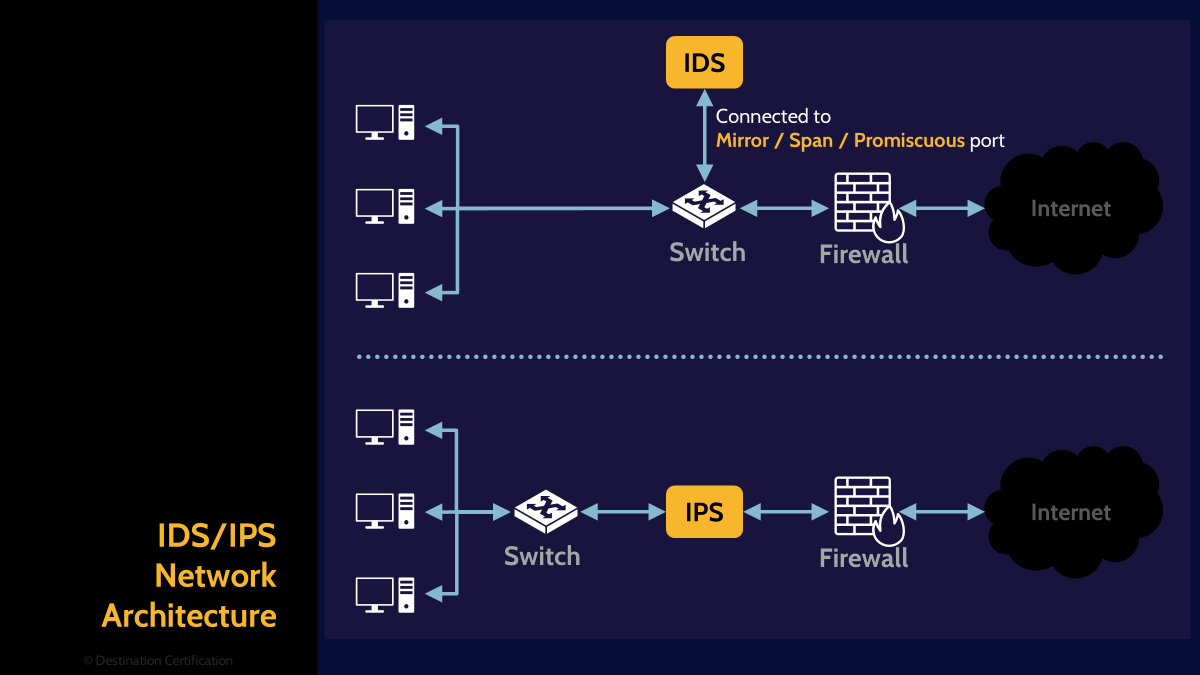
Intrusion Detection Systems monitor for suspicious activity and alert administrators, while Intrusion Prevention Systems take immediate action to block threats. The key difference lies in response - IDS observes and reports, IPS actively intervenes. Organizations often deploy both, using IDS for comprehensive monitoring and IPS at critical chokepoints where false positives could disrupt business operations.
There are multiple types of these, starting with Network-based.
Network-based
A network-based IDS/IPS works like a traffic cop at a busy intersection — watching every lane, analyzing the flow, and spotting drivers (or packets) who are speeding, swerving, or up to no good. Because it sees the whole stretch of road, it can detect attacks aimed at multiple systems at once, not just a single device.
Host-based
On the other hand, host-based IDS/IPS runs on individual servers or workstations, monitoring system calls, file integrity, and application behavior for signs of compromise.
Detection methods
Of course, simply watching traffic isn’t enough — the real question is how these systems decide what’s malicious. That’s where detection methods come in.
Detection methods determine how IDS/IPS systems identify threats, ranging from pattern matching against known signatures to behavioral analysis that spots unusual activity.
Pattern matching
Pattern matching compares network traffic or system activity against predefined patterns that represent known attacks or malicious behavior.
Anomaly
While pattern matching and other detection methods looks for known bad fingerprints, anomaly detection flips the script — it learns what ‘normal’ looks like, then flags anything out of the ordinary. That makes it powerful for spotting new, unknown attacks that don’t match existing signatures.
Honeypots/Honeynets
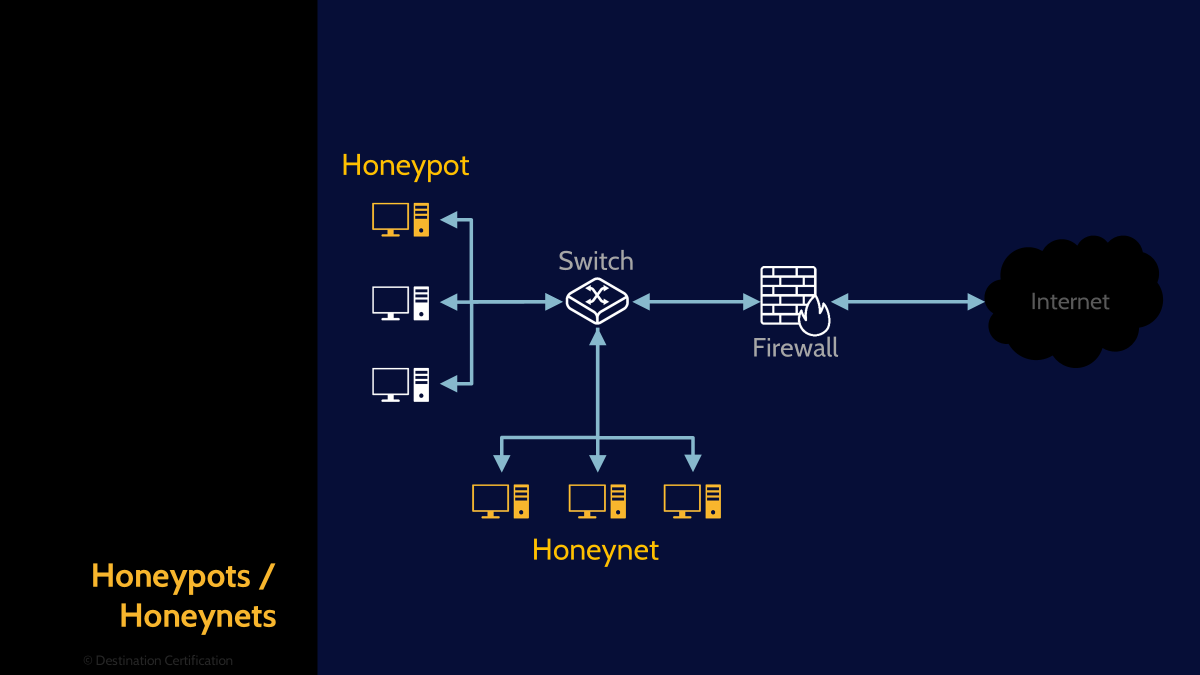
Of course, sometimes the best way to catch an attacker is to let them think they’ve won. That’s the idea behind honeypots — decoys that waste their time and collect valuable intel. They are also the next item on today’s agenda.
Honeypots are decoy systems designed to attract attackers away from real assets while gathering intelligence about their methods. Honeynets extend this concept to entire fake networks. These deception technologies serve dual purposes - they waste attackers' time and resources while providing early warning of threats and valuable threat intelligence about attack techniques and tools.
Endpoint Security
Did you think network security was the whole story? Not quite. The real action happens at the endpoints — the laptops, phones, and devices that touch the data every day.
Endpoint security protects individual devices where users interact with data. Modern endpoints face sophisticated threats that bypass network defenses through email, web browsing, and removable media, requiring dedicated protection at the device level.
EDR
The first type of endpoint security we’ll be reviewing is Endpoint Detection and Response. It continuously monitors endpoint activities, recording process execution, network connections, and file changes. EDR provides forensic capabilities that traditional antivirus lacks, enabling threat hunting and incident investigation.
Visibility
One of the main traits of EDR is that its visibility extends beyond simple malware detection to capture comprehensive endpoint telemetry. Security teams gain insight into process relationships, registry modifications, and lateral movement attempts. This deep visibility enables proactive threat hunting, allowing analysts to search for indicators of compromise across the entire endpoint fleet before attacks succeed.
Device isolation
Another important trait of EDR is device isolation, as it instantly quarantines compromised endpoints from the network while maintaining remote access for investigation. This containment prevents lateral movement and data exfiltration while preserving evidence. Isolation can be surgical - blocking only specific network segments or protocols - or complete, cutting all network access except the EDR management channel.
Evidence collection
Finally, EDR platforms automatically collect forensic artifacts during incidents, capturing memory dumps, running processes, network connections, and file system changes. This evidence supports both immediate response and post-incident analysis. Think of it as your digital security camera: even if the power blinks or the burglar tries to wipe the tapes, the trail is preserved for investigators to follow back to the culprit.
And with that thought in mind, we have wrapped up EDR and can move on to Extended Detection and Response.
XDR
It unifies security telemetry across endpoints, networks, cloud workloads, and email. XDR breaks down security silos, correlating alerts from multiple sources to reveal sophisticated attacks that span different attack vectors.
EDR + more
One way you can think of this is simply EDR + more. XDR extends EDR capabilities beyond endpoints to include network traffic analysis, cloud workload protection, and email security. This broader scope captures attacks that move between different infrastructure layers.
Expanded visibility
XDR visibility spans the entire attack surface, correlating endpoint behavior with network flows, cloud API calls, and authentication events. This holistic view reveals attack chains that individual security tools miss. Analysts see how initial compromise through phishing leads to endpoint infection, lateral movement across the network, and eventual data exfiltration to cloud storage.
Combines response actions
XDR orchestrates response actions across multiple security layers from a single console. When detecting threats, XDR can simultaneously isolate endpoints, block network connections, disable user accounts, and quarantine emails. This coordinated response contains threats faster than manually coordinating between different security tools, reducing dwell time and limiting damage.
Centralized detection
Another important trait of XDR is centralized detection. It applies unified analytics across all security telemetry, using machine learning and behavioral analysis to identify threats that manifest across multiple domains. Rather than a dozen solo musicians playing out of sync, XDR acts like a conductor — pulling the alerts together into one incident timeline that tells the full story. This reduces alert fatigue while improving detection accuracy for complex, multi-stage attacks.
MDR
The last element of endpoint security we’ll be reviewing today is Managed Detection and Response. It combines XDR technology with expert security analysts who monitor, investigate, and respond to threats on your behalf. MDR addresses the security skills gap by providing access to experienced threat hunters.
XDR + Human analysis
MDR augments XDR's automated detection with human expertise to validate alerts, investigate complex incidents, and make nuanced response decisions. Security analysts bring contextual understanding that technology alone cannot provide.
Extensive playbook use
Another element to consider is that MDR providers leverage comprehensive playbooks developed from thousands of incident responses across multiple clients. These playbooks codify best practices for investigating and remediating specific threat types.
24X7X365 monitoring support
Round-the-clock monitoring ensures threats are detected and addressed immediately, regardless of when they occur. MDR teams work in shifts across global security operations centers, maintaining vigilance during nights, weekends, and holidays when internal teams are unavailable. This continuous coverage is critical since attackers often strike during off-hours to maximize dwell time.
SOC Augmentation
A final element of MDR to consider is that MDR services augment existing Security Operations Centers by providing specialized expertise, additional capacity, and advanced threat intelligence. Rather than replacing internal teams, MDR fills gaps in coverage, handles overflow during incidents, and provides access to threat hunting capabilities. This partnership model allows organizations to maintain security ownership while leveraging external expertise for complex threats.

And that is an overview of Security Tools within Domain 3, covering the most critical concepts you need to know for the exam.
Something really cool we are providing with these MindMap videos is a completely FREE downloadable version of all the MindMaps in PDF format. We even include a blank version of each MindMap in case you want to print them out and take notes as you listen along. Link to download the MindMaps is in the description below.
If you found this video helpful you can hit the thumbs up button and if you want to be notified when we release additional videos in this MindMap series, then please subscribe and hit the bell icon to get notifications.
I will provide links to the other MindMap videos in the description below.
Thanks very much for watching! And all the best in your studies